Meta Description:
Discover how to choose the right brass ball valve for plumbing and HVAC systems. Learn about full port design, lead free brass, durability, and reliable valve manufacturing.
Brass Ball Valve: Complete Guide to Quality, Performance, and Modern Applications
In today’s plumbing, HVAC, water distribution, and industrial piping industries, the brass ball valve remains one of the most trusted and widely used flow control solutions. Its durability, easy operation, corrosion resistance, and long service life make it an essential component in residential, commercial, and industrial systems worldwide.
However, not all valves are manufactured to the same quality standard. Some products fail quickly under pressure, while others continue operating reliably for many years. Buyers often wonder why certain valves are extremely cheap while professional-grade valves cost more.
The difference usually comes down to:
- Material quality
- Manufacturing precision
- Internal structure design
- Sealing performance
- Testing standards
- Long-term durability
This guide explains everything you need to know about choosing high-quality ball valves, understanding valve construction, and selecting reliable suppliers for modern HVAC and plumbing applications.
What Is a Brass Ball Valve?
A brass ball valve is a quarter-turn shut-off valve designed to control the flow of liquids or gases through a piping system.
Inside the valve body is a polished brass ball with a hole through the center. When the handle rotates 90 degrees, the hole either aligns with the pipeline to allow flow or blocks it completely.
Because of their simple structure and reliable sealing performance, brass ball valves are commonly used in:
- Residential plumbing systems
- HVAC systems
- Underfloor heating systems
- Water treatment systems
- Commercial buildings
- Industrial fluid control applications
Their compact design and smooth operation make them one of the most popular valve types globally.
Why Brass Is Widely Used in Valve Manufacturing
Brass offers several important advantages compared to other materials.
These include:
- Excellent corrosion resistance
- Long service life
- Good machinability
- Stable sealing performance
- Strong pressure resistance
High-quality brass materials also perform well in hot and cold water systems.
Modern lead free brass materials are increasingly preferred in global plumbing markets because they help meet stricter environmental and drinking water standards.
Understanding Full Port Valve Design
One of the most important features in professional valve systems is the full port design.
A full port valve has an internal opening that matches the diameter of the pipeline. This allows unrestricted flow with minimal pressure loss.
Advantages of full port valves include:
- Better flow efficiency
- Reduced pressure drop
- Improved system performance
- Lower energy consumption
- Better performance in HVAC systems
Full port valve designs are especially important in:
- Heating systems
- Water circulation systems
- Pump applications
- Industrial fluid systems
Many low-cost valves use reduced-port designs to save material costs, but this can negatively affect system efficiency.
Brass vs Stainless Steel Ball Valves
Both brass and stainless steel valves are widely used in the market, but each has different advantages.
Brass Valves
Advantages include:
- Lower manufacturing cost
- Excellent machinability
- Reliable sealing
- Ideal for plumbing and HVAC systems
Brass valves are commonly used in residential and commercial applications.
Stainless Steel Valves
Advantages include:
- Higher corrosion resistance
- Better chemical resistance
- Stronger high-temperature performance
Stainless steel valves are commonly used in:
- Chemical processing
- Marine applications
- Industrial systems
- Food-grade applications
For most plumbing and HVAC projects, high-quality brass valves provide excellent reliability and cost performance.
Why Valve Quality Matters
Many buyers focus only on price when sourcing valves.
However, poor-quality valves often create much larger long-term costs.
Low-grade products may experience:
- Leakage
- Cracking
- Corrosion
- Handle failure
- Internal sealing damage
- Short lifespan
These failures can lead to:
- Expensive repairs
- Water damage
- Customer complaints
- HVAC system inefficiency
- Installation labor losses
Professional contractors and distributors increasingly prioritize stable quality over extremely cheap pricing.
Common Applications for Ball Valves
Ball valves are used across a wide range of industries because of their versatility and durability.
Plumbing Systems
Residential and commercial plumbing systems rely on ball valves for reliable shut-off control.
Applications include:
- Water supply lines
- Bathroom systems
- Kitchen systems
- Main water shut-off systems
HVAC Systems
Modern HVAC systems require precise flow control and dependable sealing performance.
Ball valves are widely used in:
- Heating systems
- Chilled water systems
- Fan coil units
- Boiler systems
- Heat pump systems
Underfloor Heating Systems
Hydronic underfloor heating systems commonly use brass ball valves together with:
- Brass manifolds
- Balancing valves
- Mixing valve systems
Reliable flow control is essential for system efficiency and temperature stability.
Industrial Piping Systems
Industrial facilities use ball valves for:
- Water systems
- Air systems
- Oil systems
- Non-aggressive fluid control
High-pressure applications often require stronger material standards and advanced sealing designs.
Key Features of High-Quality Ball Valves
Professional-grade valves are designed for long-term performance.
Important quality factors include:
Precision Machining
Advanced CNC machining ensures:
- Accurate dimensions
- Smooth operation
- Better sealing contact
- Stable thread quality
Precision manufacturing greatly improves valve lifespan.
Reliable PTFE Sealing
PTFE sealing seats provide:
- Excellent wear resistance
- Stable sealing performance
- Long service life
- Smooth handle operation
Low-quality seals often harden or fail over time.
Thick Valve Body Construction
Strong valve bodies improve:
- Pressure resistance
- Structural stability
- Safety performance
Very thin valve bodies may crack under pressure or temperature changes.
Surface Finishing
Professional surface treatment improves:
- Corrosion resistance
- Appearance quality
- Long-term durability
Growing Demand for Lead Free Brass Valves
Global regulations increasingly require safer materials in plumbing systems.
Lead free brass products are becoming more important in:
- Drinking water systems
- Residential plumbing
- European markets
- North American markets
Many distributors now prioritize environmentally compliant valve solutions.
How to Choose the Right Valve Supplier
Choosing the right manufacturer is critical for long-term business success.
Important factors include:
- Production capability
- Quality control systems
- Material standards
- Export experience
- OEM customization support
- Stable delivery capability
Reliable suppliers help reduce quality risks and improve customer satisfaction.
Why Global Customers Choose BORNIC
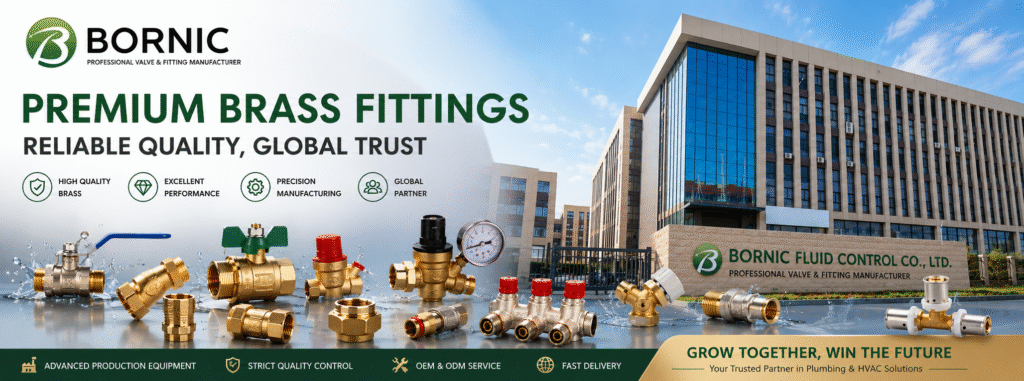
At BORNIC, we specialize in manufacturing high-quality brass valves, HVAC components, plumbing fittings, and hydronic heating solutions for global markets.
Our product range includes:
- Brass ball valves
- Balancing valves
- Brass manifolds
- Check valves
- Angle valves
- Plumbing fittings
- HVAC accessories
BORNIC products are trusted by customers in Europe, South America, the Middle East, and other international markets.
BORNIC Manufacturing Advantages
Our production focuses on balancing quality, durability, and competitive pricing.
Key advantages include:
- High-quality brass materials
- Advanced CNC machining
- Strict leakage testing
- Stable product consistency
- Professional export experience
- OEM & ODM capability
Unlike extremely low-cost products that sacrifice quality for price, BORNIC valves are designed for reliable long-term performance.
Strict Quality Control Standards
Quality inspection is integrated into every production stage.
Our testing procedures include:
- Air pressure testing
- Water leakage testing
- Torque testing
- Surface inspection
- Raw material verification
- Thread accuracy inspection
This helps ensure every valve meets professional quality standards before shipment.
Why Mid-Range Professional Valves Offer Better Value
The valve market generally includes three categories:
| Category | Characteristics |
|---|---|
| Low-cost valves | Cheap price, inconsistent quality |
| Professional mid-range valves | Best balance of price and reliability |
| Premium luxury brands | Very high pricing |
BORNIC focuses on providing professional-quality valves with practical pricing for long-term customer value.
This approach helps customers reduce:
- Failure rates
- After-sales problems
- Replacement costs
- Warranty claims
Future Trends in the Valve Industry
Modern plumbing and HVAC systems increasingly demand:
- Better energy efficiency
- Safer materials
- Higher durability
- Smart system compatibility
- Improved corrosion resistance
As construction standards continue rising worldwide, demand for reliable professional valve solutions will continue growing.
Final Thoughts
The global valve market is highly competitive, but long-term success depends on quality, reliability, and trust.
Choosing the right ball valves is not only about price — it is about:
- Safety
- Durability
- Performance
- Customer satisfaction
- Long-term operating reliability
High-quality valves help protect plumbing systems, improve HVAC efficiency, and reduce maintenance problems.
At BORNIC, we remain committed to providing reliable brass valve solutions trusted by global customers across residential, commercial, and industrial markets.
With professional manufacturing capability, strict quality control, and extensive export experience, BORNIC continues to support customers worldwide with dependable valve products built for modern systems and long-term performance.