
Plumbing Valves OEM
When sourcing plumbing products for distribution, construction projects, or private-label brands, choosing the right plumbing valves OEM can have a significant impact on product quality, cost, delivery time, and long-term business growth.
A professional OEM valve manufacturer does more than simply produce a standard valve according to a drawing. The right manufacturing partner should be able to support product development, material selection, machining, assembly, testing, packaging, certification, and customization while maintaining consistent quality from one production batch to the next.
For wholesalers, importers, plumbing brands, HVAC companies, and engineering contractors, understanding how plumbing valves are manufactured and how to evaluate an OEM supplier is therefore essential.
This guide explains what to look for in a plumbing valves OEM manufacturer, the most common types of valves, important materials and standards, OEM customization options, quality-control procedures, and how to select a reliable long-term manufacturing partner.
What Is a Plumbing Valves OEM?
A plumbing valves OEM is a manufacturer that produces valves and related plumbing components for another company, brand, distributor, or importer.
Instead of selling products only under its own brand, an OEM manufacturer can produce products according to the customer’s:
- Product drawings
- Technical specifications
- Material requirements
- Dimensions
- Pressure ratings
- Surface finishes
- Packaging requirements
- Branding
- Certification requirements
- Quality-control standards
This allows a plumbing company to develop its own product range without investing in an entire valve manufacturing facility.
For example, a distributor may want to sell a brass ball valve under its own brand. An OEM manufacturer can produce the valve with the distributor’s logo, packaging, product codes, and specific technical requirements.
A complete OEM program can cover everything from prototype development to mass production.
Why Choose a Professional Plumbing Valve OEM?
The plumbing valve market is highly competitive. Many manufacturers can produce inexpensive valves, but consistent quality and reliable production are much more difficult to achieve.
A professional OEM supplier can provide several important advantages.
1. Consistent Product Quality
For distributors and brands, consistency is extremely important.
A valve that performs well in one shipment but has different dimensions, surface quality, or sealing performance in the next shipment can create serious problems for customers.
Professional OEM manufacturers normally establish controlled specifications for:
- Brass composition
- Body dimensions
- Thread dimensions
- Machining tolerances
- Sealing materials
- Assembly torque
- Pressure testing
- Packaging
This helps maintain stable quality across large production volumes.
2. Better Cost Control
OEM manufacturing allows buyers to purchase directly from the factory instead of relying on multiple layers of distributors.
When annual purchasing volume increases, manufacturers can also optimize:
- Raw material purchasing
- Forging processes
- CNC machining
- Assembly
- Packaging
- Production planning
As a result, the total cost per valve can often be reduced.
However, the lowest initial price should not be the only consideration. A valve with a lower purchase price but a higher rejection rate or shorter service life may ultimately cost more.
3. Private Label Manufacturing
Many plumbing companies want to develop their own brands.
A plumbing valves OEM can manufacture products with customized:
- Logos
- Laser markings
- Handles
- Labels
- Cartons
- Polybags
- Product codes
- Instruction manuals
This is particularly useful for distributors that want to build a recognizable plumbing brand rather than compete solely on price.
Common Types of Plumbing Valves
A professional plumbing valve manufacturer should be able to provide a broad product portfolio covering different water-control applications.
Brass Ball Valve
The brass ball valve is one of the most widely used valves in residential, commercial, and industrial plumbing.
It uses a spherical ball with a central opening to control water flow. When the handle is turned, the ball rotates between the open and closed positions.
Typical applications include:
- Domestic water supply
- Heating systems
- HVAC
- Irrigation
- Industrial water systems
- Solar water systems
Ball valves are popular because they provide simple operation, relatively low flow resistance, and reliable shut-off performance.
For OEM buyers, important specifications include connection type, pressure rating, body material, ball material, stem design, seal material, and handle configuration.
Check Valve
A check valve allows fluid to flow in one direction while preventing reverse flow.
It is commonly installed in:
- Water supply systems
- Pump systems
- Heating systems
- Boiler systems
- Irrigation
- HVAC installations
Different designs include spring check valves, swing check valves, vertical check valves, and wafer-style check valves.
When selecting a check valve, buyers should consider flow direction, installation position, pressure rating, cracking pressure, sealing performance, and the type of fluid being handled.
For OEM production, the internal design is particularly important because incorrect spring selection or poor machining can affect opening pressure and backflow prevention.
Pressure Relief Valve
A pressure relief valve is designed to protect a plumbing or heating system from excessive pressure.
When system pressure reaches a predetermined level, the valve opens and releases pressure.
These valves are frequently used in:
- Water heaters
- Heating systems
- Boilers
- Solar thermal systems
- Water supply equipment
- Pressure vessels
For OEM applications, pressure-setting accuracy is critical.
Manufacturers should have suitable testing equipment to verify the opening pressure and sealing performance of each production batch.
Pressure Reducing Valve
A pressure reducing valve controls excessive inlet pressure and provides a lower, more stable downstream pressure.
This type of valve is particularly useful when the incoming water pressure is higher than the pressure required by the plumbing system.
Typical applications include:
- Residential buildings
- Commercial buildings
- Water supply systems
- Heating systems
- Industrial water networks
For a pressure reducing valve OEM, diaphragm quality, spring performance, internal machining, adjustment accuracy, and pressure stability are all important.
Toilet Fill Valve
A toilet fill valve is a common component in residential plumbing systems. It controls the water entering a toilet tank after flushing.
Although its design is different from brass pipeline valves, it represents another important category within the broader plumbing component market.
OEM buyers should pay attention to:
- Water inlet connection
- Filling speed
- Noise level
- Water-saving performance
- Float mechanism
- Seal quality
- Compatibility with different toilet tanks
For companies selling complete plumbing product ranges, adding toilet fill valves and other sanitary components can complement a traditional brass valve portfolio.
Materials Used in Plumbing Valve Manufacturing
Material selection has a direct influence on valve performance, cost, durability, and regulatory compliance.
For brass plumbing valves, commonly used materials include different grades of brass according to the intended application.
The appropriate material depends on:
- Working pressure
- Temperature
- Fluid type
- Corrosion requirements
- Machining requirements
- Forging requirements
- Applicable standards
- Customer requirements
Brass
Brass is widely used because it offers a good balance of mechanical strength, corrosion resistance, machinability, and cost.
Different brass grades can be selected depending on whether the product is intended for general plumbing, potable water, heating, gas, or other applications.
For OEM projects, buyers should request the manufacturer’s material specification rather than simply asking for “brass.”
Stainless Steel
Stainless steel valves are often selected where higher corrosion resistance or specific chemical compatibility is required.
They can be suitable for demanding environments, although the material cost is generally higher than brass.
Engineering Plastics
Some plumbing components, particularly lightweight residential products, may use engineered plastics.
Plastic valves can provide advantages in terms of weight and corrosion resistance, depending on the application.
OEM Customization Options
One of the biggest advantages of working directly with an OEM manufacturer is customization.
A professional manufacturer can often modify the product according to the buyer’s requirements.
Product Customization
Possible modifications include:
- Body dimensions
- Connection size
- Thread standard
- Handle shape
- Handle color
- Stem design
- Internal components
- Spring
- Diaphragm
- Seal material
Branding
OEM products can also be customized with the buyer’s brand identity.
Common options include:
- Laser logo
- Embossed logo
- Printed logo
- Branded handles
- Customized labels
- Customized cartons
- Barcode labels
Packaging
Packaging can be designed according to the customer’s sales channel.
For example, a distributor may require bulk industrial packaging, while a retail brand may require individual color boxes with product photography, specifications, barcodes, and installation instructions.
Quality Control in Plumbing Valve OEM Manufacturing
Quality control should begin before production starts.
A reliable manufacturer should have procedures covering raw materials, machining, assembly, testing, and final inspection.
Raw Material Inspection
Brass materials should be checked according to the agreed specification.
Depending on the project, manufacturers may verify:
- Chemical composition
- Material grade
- Dimensions
- Surface quality
- Mechanical properties
CNC Machining Inspection
Valve bodies require accurate machining to ensure correct assembly and sealing.
Important inspection points include:
- Thread accuracy
- Bore dimensions
- Sealing surfaces
- Stem holes
- Connection dimensions
- Critical tolerances
Pressure Testing
Pressure testing is one of the most important stages of valve production.
Depending on the product, manufacturers may perform:
- Body pressure tests
- Shell tests
- Seat leakage tests
- Air tests
- Functional tests
The exact testing method and pressure should follow the applicable product standard or agreed technical specification.
Final Inspection
Before shipment, finished valves should be inspected for:
- Appearance
- Dimensions
- Markings
- Operation
- Leakage
- Packaging
- Quantity
A systematic inspection process reduces the risk of receiving inconsistent products.
Certifications and Standards
Different markets have different requirements for plumbing products.
Before placing an OEM order, buyers should determine which standards and certifications are required for their destination market.
Depending on the application, these may include requirements related to:
- Drinking water
- Plumbing
- Heating
- Gas
- Pressure equipment
- Material safety
- Environmental requirements
European, North American, Middle Eastern, Latin American, and other markets can have different regulatory requirements.
A professional OEM manufacturer should be able to discuss the applicable requirements before production instead of simply offering a generic certificate.
This is especially important for products used with potable water, where material composition and hygienic performance can be critical.
How to Choose a Reliable Plumbing Valves OEM
Price is important, but it should not be the only factor.
When comparing manufacturers, buyers should evaluate at least six areas.
Manufacturing Capability
Ask whether the supplier actually manufactures the products or mainly trades products from other factories.
An actual manufacturer generally has greater control over:
- Materials
- Production
- Quality
- Delivery
- Customization
Product Range
A supplier with a broad product portfolio can simplify procurement.
For example, a single OEM partner may provide:
Ball Valves + Check Valves + Gate Valves + Angle Valves + Pressure Reducing Valves + Safety Valves + Manifolds + Plumbing Fittings
This can reduce the number of suppliers a buyer needs to manage.
Technical Support
A good OEM supplier should be able to understand drawings, specifications, material requirements, pressure ratings, and application conditions.
This becomes particularly important when developing customized products.
Production Capacity
Ask about production capacity and lead time before placing a large order.
A supplier should be able to explain:
- Minimum order quantity
- Sample lead time
- Mass-production lead time
- Monthly capacity
- Raw material availability
- Packaging capacity
Quality Management
Request information about inspection procedures and testing equipment.
For large projects, buyers can also consider third-party inspection before shipment.
Communication
Long-term OEM relationships require clear communication.
A good supplier should respond quickly and provide clear answers regarding:
- Pricing
- Drawings
- Samples
- Technical specifications
- Production schedules
- Quality issues
- Shipping
Why Long-Term OEM Partnerships Matter
A plumbing valve is not simply a commodity. Small improvements in design, materials, machining, and assembly can make a significant difference when thousands or millions of units are sold.
A long-term OEM partnership allows both sides to improve the product over time.
For example, after receiving market feedback, a buyer may want to improve:
- Handle design
- Flow performance
- Sealing life
- Packaging
- Weight
- Material efficiency
- Installation convenience
The OEM manufacturer can then optimize the design while maintaining compatibility with existing tooling and production processes.
This is much more efficient than changing suppliers for every new project.
BORNIC as a Plumbing Valves OEM Partner
For brands, distributors, wholesalers, and engineering companies looking for a long-term plumbing valves OEM, BORNIC provides a manufacturing-oriented approach to brass valves and plumbing flow-control products.
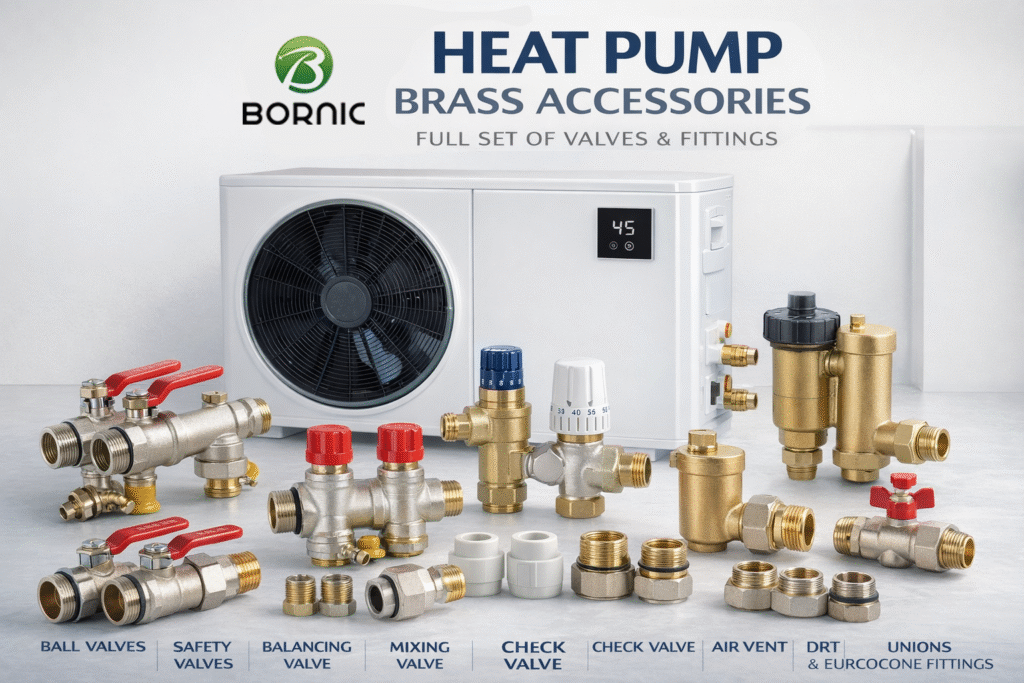
The product portfolio can cover various plumbing and HVAC applications, including brass ball valves, check valves, angle valves, gate valves, pressure reducing valves, safety valves, radiator valves, manifolds, filters, and related plumbing components.
OEM cooperation can be developed around the customer’s product specifications, branding, packaging, market requirements, and target application.
Rather than focusing only on the lowest purchase price, the goal of a professional OEM partnership should be to achieve a practical balance between quality, cost, reliability, customization, and delivery performance.
Frequently Asked Questions About Plumbing Valves OEM
What does plumbing valves OEM mean?
Plumbing valves OEM means that a manufacturer produces plumbing valves for another company or brand according to specified designs, materials, technical requirements, branding, and packaging.
What is the most common plumbing valve?
The ball valve is one of the most widely used plumbing valves because it provides simple operation and reliable shut-off for many water and HVAC applications.
What is a check valve used for?
A check valve prevents fluid from flowing backward through a pipeline. It is commonly used in water supply, pump, heating, irrigation, and HVAC systems.
What is a pressure relief valve used for?
A pressure relief valve protects equipment and piping systems from excessive pressure by opening when pressure reaches a predetermined setting.
Can plumbing valves be customized?
Yes. OEM manufacturers can customize dimensions, materials, handles, markings, logos, packaging, connections, and other specifications depending on the product and production requirements.
How do I choose a plumbing valve manufacturer?
Evaluate manufacturing capability, material quality, testing procedures, certifications, production capacity, OEM experience, customization capability, communication, and total cost rather than comparing unit prices alone.
Conclusion
Choosing the right plumbing valves OEM is an important decision for plumbing brands, distributors, wholesalers, contractors, and engineering companies.
A reliable manufacturer should offer more than competitive pricing. It should provide stable materials, accurate machining, dependable sealing performance, systematic pressure testing, flexible OEM customization, appropriate certifications, and reliable delivery.
Whether you are sourcing a brass valve, check valve, pressure reducing valve, pressure relief valve, toilet fill valve, or a complete plumbing valve range, the best OEM partner is one that understands both the technical requirements of the product and the commercial needs of your market.
For companies planning to build or expand their own plumbing brand, establishing a long-term relationship with a capable OEM manufacturer can provide better control over product quality, pricing, branding, and future product development.
Looking for a reliable plumbing valves OEM for your brand or distribution business? Contact BORNIC to discuss your product requirements, OEM specifications, samples, packaging, and bulk-order opportunities.
